
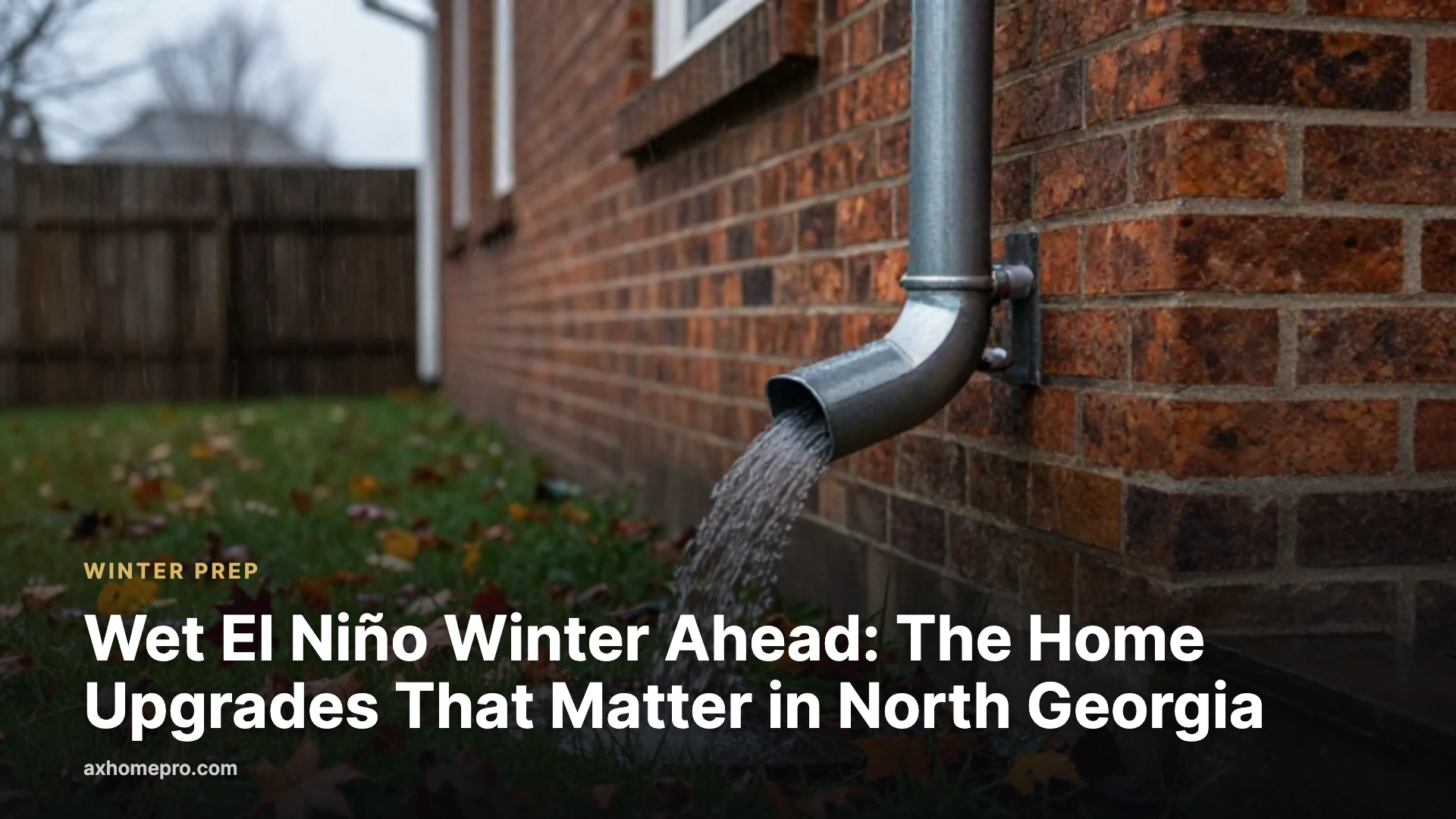
Federal forecasters expect one of the strongest El Niño events on record to tilt Georgia toward a wetter-than-normal winter, and with federal energy-efficiency tax credits gone for 2026 projects, North Georgia homeowners face a different calculation on gutters, insulation and heating work this fall.
A super El Niño tilts the odds toward a wet winter
NOAA’s Climate Prediction Center released its U.S. winter outlook for December through February on Oct. 15, 2026. An El Niño advisory is in effect, and the agency gave an 83% chance that the October-to-December strength of the event will exceed every El Niño in its records dating to 1950, according to The Watchers and The Weather Channel.
The outlook favors wetter-than-average conditions across the southern tier of the country, including the Southeast, with near-normal temperatures most likely across parts of the region. National Weather Service Director Ken Graham said the pattern “tilts the odds toward stormier weather across the South.” Drought improvement or removal is favored in the Southeast through January.
For Georgia specifically, an earlier Climate Prediction Center outlook described by Patch on Oct. 1 called for near-normal temperatures statewide and above-average precipitation, with the strongest wet signal in central and south Georgia. The northern third of the state could see more chances for snow, sleet or freezing rain when cold air lines up with storms. Georgia Public Broadcasting noted that the closest historical comparisons, including the 1997-98 winter, brought some of the wettest Februaries on record. NOAA’s next monthly update is scheduled for Nov. 19.
Heating bills: a mixed picture
The U.S. Energy Information Administration’s Winter Fuels Outlook, published Oct. 7, projects household heating spending from November through March to fall 9% for natural gas and 3% for propane compared with last winter. Average electricity bills are expected to rise 4%, and heating oil spending is forecast to jump 21%, though oil heats only about 3% of U.S. homes, mostly in the Northeast. EIA expects temperatures in the South to be similar to last winter.
Electricity is the main heating source in more than 40% of U.S. homes, and natural gas and propane together heat about half. That makes the electricity forecast the most relevant for many North Georgia households with heat pumps.
Georgia Power customers saw a modest reduction earlier this year. The Georgia Public Service Commission voted unanimously on May 28 to approve a plan that lowered the utility’s fuel rate while recovering Hurricane Helene storm costs, cutting the typical 1,000-kilowatt-hour residential bill by about $4.04 a month, or about $50 a year. The change took effect June 1. Commissioner Peter Hubbard, who voted for unsuccessful amendments, argued the commission “missed opportunities to save Georgia families another $50 million.” Georgia Power’s base rates are frozen through 2028 under an earlier agreement.
Federal tax credits are gone for 2026 projects
The federal Energy Efficient Home Improvement Credit, which covered insulation, air sealing, efficient windows and doors, home energy audits and heat pumps, applied only to property placed in service before the end of 2025, according to the IRS. The credit had been worth up to $1,200 a year for most improvements and up to $2,000 for qualifying heat pumps and heat pump water heaters. It was ended early by the federal tax and spending law signed July 4, 2025, and the Southern Alliance for Clean Energy confirmed the credits are not available for 2026 work.
That means a homeowner who adds attic insulation or replaces a furnace with a heat pump this winter cannot claim the credit on a 2026 return.
Georgia’s state rebates fill part of the gap
The state’s Georgia Home Energy Rebates program, run by the Georgia Environmental Finance Authority with federal funds, remains the main incentive. GEFA said in April that the program had paid more than $25 million in rebates since its full launch on March 31, 2025, with more than 1,900 households saving an average of $1,465 a year in estimated energy costs on an average rebate of $10,160.
The program has two parts. The efficiency rebates, open to all income levels, cover whole-home upgrades that cut energy use by at least 20%, paying 50% of project cost up to $4,000 for most households and up to 98% of cost, capped at $16,000, for households below 80% of area median income. An approved contractor must perform an energy assessment first. The electrification rebates, limited to households below 150% of area median income, cover up to $1,600 for insulation, air sealing and ventilation and up to $8,000 for a heat pump. The program’s website says that portion “will reopen with limited measures in October 2026.”
The upgrades that matter in a wet winter
Because the strongest signal in this year’s outlook is rain rather than cold, water management moves to the top of the list. Gutters, downspout extensions and grading determine whether heavy rain ends up in a crawl space or basement. Roof flashing and valleys deserve a look before the stormiest months arrive.
Insulation and air sealing remain the upgrades most directly tied to heating costs and are eligible under both state rebate programs. Mineral wool insulation prices rose just 1.6% over the past year, according to federal producer price data, a smaller increase than most building materials. For heat pump owners facing a projected 4% rise in electricity bills, a fall tune-up and a check of the auxiliary heat strips are low-cost steps that can prevent surprise bills during cold snaps.
The AX Home Pro Take
The end of the federal credit changes the order of operations for many homeowners. Last year, a homeowner could insulate, claim the credit and move on. This year, the state rebate is the main financial help, and its efficiency track requires an assessment by an approved contractor before work begins. Homeowners who start a project first and ask about rebates later may find they no longer qualify.
The forecast also argues for sequencing. Drainage and roof repairs protect the house from the season’s most likely threat, so they make sense before insulation or equipment upgrades. North Georgia homes with crawl spaces are especially worth inspecting, since moisture problems there can undermine insulation and air quality at the same time.
Finally, timing matters. Remodelers nationally are reporting longer schedules because of labor shortages, so homeowners who want work finished before the wettest stretch of winter should book this fall rather than after the first heavy storm.
What it means for you
- Clear and extend: Clean gutters after leaf fall and make sure downspouts discharge well away from the foundation before December’s rains.
- No federal credit: Insulation, windows and heat pumps installed in 2026 do not qualify for the expired Energy Efficient Home Improvement Credit.
- Check state rebates first: Use the Georgia Home Energy Rebates site to confirm eligibility and find an approved contractor before signing a contract.
- Service the heat pump: With electricity bills forecast to rise about 4%, a tune-up before the first cold snap is a modest cost.
- Watch for ice: Homes in the northern third of Georgia should insulate exposed pipes in crawl spaces and garages in case cold air arrives with a storm.
Test yourself
1. When did NOAA release its 2026-27 U.S. winter outlook?
Answer: On Oct. 15, 2026, with an update scheduled for Nov. 19.
2. What does EIA expect to happen to average electricity bills this winter?
Answer: A rise of about 4%, while natural gas spending is projected to fall 9%.
3. Can homeowners claim the federal Energy Efficient Home Improvement Credit for insulation installed in 2026?
Answer: No; the credit applied only to property placed in service before the end of 2025.
4. What must happen before work begins under Georgia’s efficiency rebate track?
Answer: An approved program contractor must complete an energy assessment.
Discussion
- With the federal credit gone, would you still invest in insulation or a heat pump this year, or wait for new incentives?
- Which matters more for your home this winter: drainage and roof work or heating efficiency?
- Have Georgia Power or EMC bills changed how you heat your home over the past year?
Sources
- The Watchers — Very strong El Nino favors wetter South and warmer North in NOAA’s 2026-27 winter outlook
- The Weather Channel — What historic super El Nino ahead means for your fall, winter
- NewsNation — What will your winter look like? NOAA releases 2026-27 weather outlook
- Patch — New Map Predicts 2026-27 Winter Forecast: What It Means For GA Snow
- Georgia Public Broadcasting — A super El Nino is predicted to hit the U.S. What that means for Georgia
- U.S. Energy Information Administration — Mixed outlook for energy expenditures this winter
- Georgia Power — Georgia PSC approves plan to lower overall rates
- The Current — Commission approves Georgia Power fuel rate decrease
- Internal Revenue Service — Energy Efficient Home Improvement Credit
- Southern Alliance for Clean Energy — Big rebates available to Georgia residents for home energy improvements
- Georgia Environmental Finance Authority — Georgia’s Home Energy Rebates surpasses $25 million milestone
- Georgia Home Energy Rebates — Georgia Home Energy Rebates program site



Leave a Reply