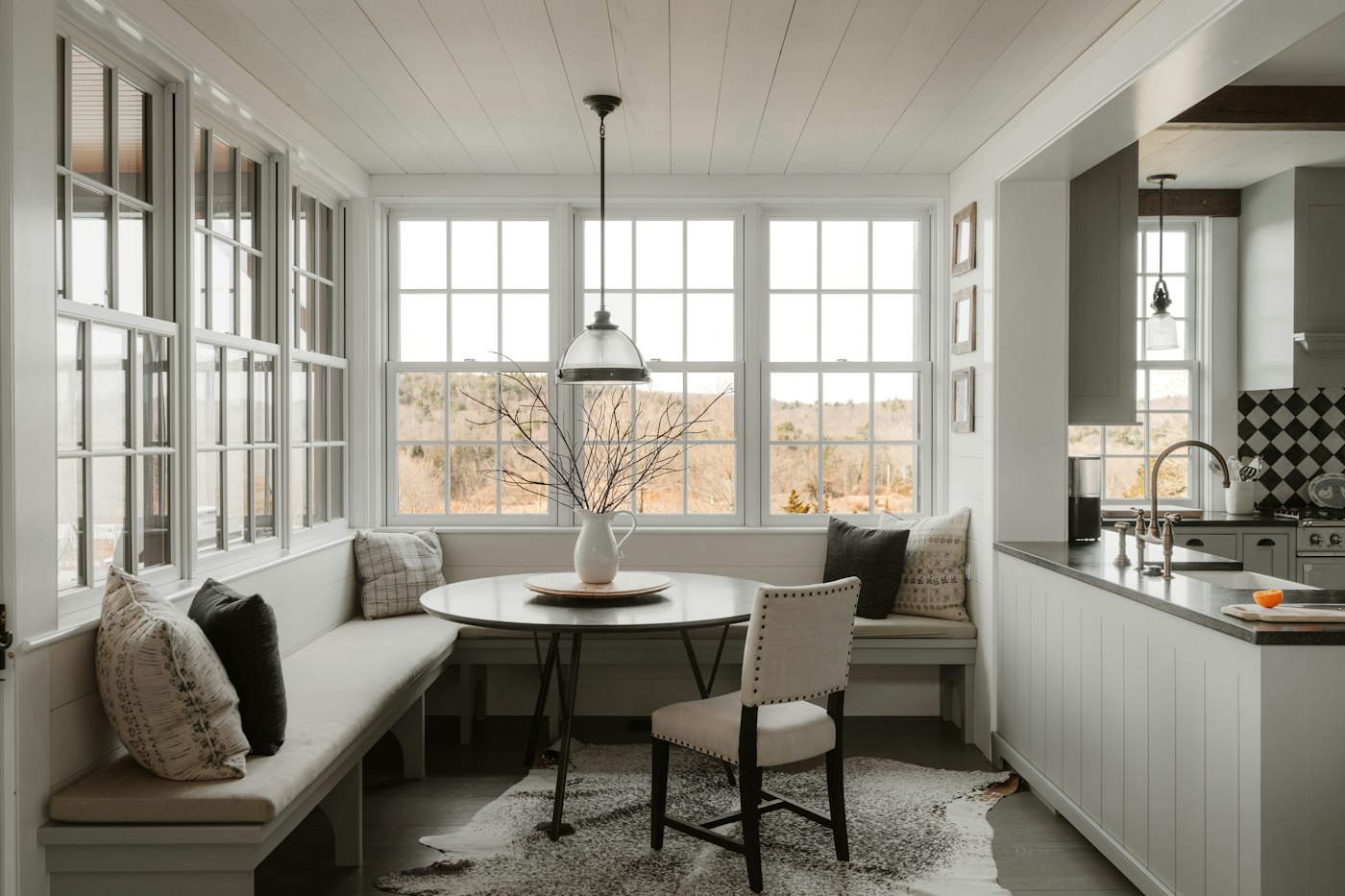
Something about a bench in a kitchen draws people in. Children do homework there, guests gravitate toward it with a glass of wine, and the family dinner that would have scattered across the island settles in around the table. A built-in banquette or breakfast nook also solves practical problems: it seats more people in less floor space than chairs, it tucks into corners and bay windows that otherwise go unused, and it can hide a surprising amount of storage.
Where a Banquette Works
The classic spot is a corner, where an L-shaped bench runs along two walls and a table sits in the angle. A bay or bow window is another natural home, with a bench following the window’s shape. A straight bench against one wall, paired with chairs on the other side of the table, is the simplest version and fits a narrower room. The end of an island can take a short bench on its back side for a cozy two-seater. Wherever it goes, people on the inside seat must be able to slide in and out, so the table should not be too deep and the bench should leave room at its ends.
Getting the Dimensions Right
Built-in seating is comfortable only when its proportions are correct, and the numbers are different from kitchen cabinets. The seat height, with the cushion compressed, should be roughly that of a dining chair. The seat should be deep enough for comfort but shallow enough that sitters can reach the table; most banquettes are deeper than a chair seat because a cushion against the back takes up some of the depth. A slightly angled back is far more comfortable than a vertical one. The table top should overlap the bench a little so plates are within reach, and the gap between the bench front and the table edge should allow legs to slide through. A designer or carpenter who has built banquettes will have these dimensions at hand.
Storage Underneath
- Lift-up seats, with hinged lids, hold seasonal items and bulky equipment but are awkward to open when people are sitting.
- Drawers in the bench front pull out toward the room and are the most convenient for daily use.
- Doors on the bench front suit items used occasionally.
- Open cubbies at the ends hold cookbooks or baskets.
A banquette along an exterior wall can also conceal a radiator or heating duct with a vented toe kick.
Cushions and Fabrics
The bench is where food is dropped, so the cushions should be practical. Performance fabrics designed to resist stains and clean with water have made upholstered banquettes realistic for families. Removable covers with zippers can be washed. Firm foam holds its shape better than soft foam, and a slightly thinner seat cushion keeps the seat height correct. A wood or painted bench with loose cushions is the easiest to maintain; a fully upholstered bench looks the most finished.
Tables, Lighting and Details
A pedestal table is the standard partner for a banquette because it has no legs to collide with knees as people slide in. Round and oval tops ease the corners. A pendant or small chandelier centered over the table defines the nook and lights the homework. If the bench sits under a window, consider a shade that handles sun and a sill deep enough for a plant or a cup. Outlets at the ends of the bench or in the bench face serve laptops and phones.
A banquette can be built by a finish carpenter from framing and plywood, assembled from stock cabinets with a plywood seat, or ordered as custom millwork. Whichever path you take, mock up the footprint with a bench and a table before committing. The best nooks are the ones you can already picture the family sitting in.
Planning a Nook Step by Step
A built-in bench looks simple, but it is fixed in place, so planning ahead matters. This sequence helps get it right the first time.
- Choose the location. Look for an underused corner, a window or a wall near the kitchen work area but out of the main path between the sink, range and refrigerator.
- Decide how many people it should seat. Think about daily meals and gatherings, and whether chairs will complete the seating.
- Choose the table first. The table’s size and shape determine bench lengths and clearances. Bring home a table, or mark its outline on the floor.
- Mock it up. Use a bench, boxes or chairs to test how it feels to slide in and sit. Sit for a while, not just a moment.
- Plan the extras. Decide on storage, outlets, a heat register or lighting before construction begins.
- Select finishes. Choose paint, wood, cushions and fabrics that coordinate with the kitchen cabinets and counters.
Design Ideas for Different Kitchens
- Farmhouse. A painted bench with beadboard or board-and-batten back, a wood table and plaid or striped cushions.
- Modern. A clean, upholstered bench in a solid color, a round table with a simple base and a sculptural pendant.
- Traditional. A paneled bench that matches the kitchen cabinets, a pedestal table and a small chandelier.
- Coastal or casual. A light wood or white bench, outdoor-rated performance fabric and woven baskets in open cubbies.
- Small kitchen. A straight bench along one wall with a narrow table and two chairs, or a compact corner bench with a small round table.
Common Mistakes
- A bench that is too high. Forgetting the cushion’s thickness can leave feet dangling and knees jammed under the table.
- A table with legs in the way. Four-legged tables make sliding in awkward. Pedestal or trestle bases work better.
- A vertical back with no support. Sitting upright against a flat wall is uncomfortable. A slight angle or a back cushion helps.
- Hard-to-clean fabrics. Kitchen seating sees spills. Choose fabrics that can be wiped or washed.
- Blocking a window or vent. Make sure the bench does not interfere with window operation or heating and cooling airflow.
Questions Homeowners Ask
Can we add a banquette without a full remodel?
Often, yes. A banquette can be built into an existing kitchen with minimal disruption, especially if it does not require moving outlets or vents.
Is a banquette comfortable for adults?
It is when the dimensions are right. A well-proportioned bench with a good cushion and back angle can be as comfortable as dining chairs.
How do we keep the cushions in place?
Nonslip pads, ties, hook-and-loop fasteners or a shallow lip at the front of the seat keep cushions from sliding. We are glad to help you design a nook that fits your kitchen and the way your family gathers.