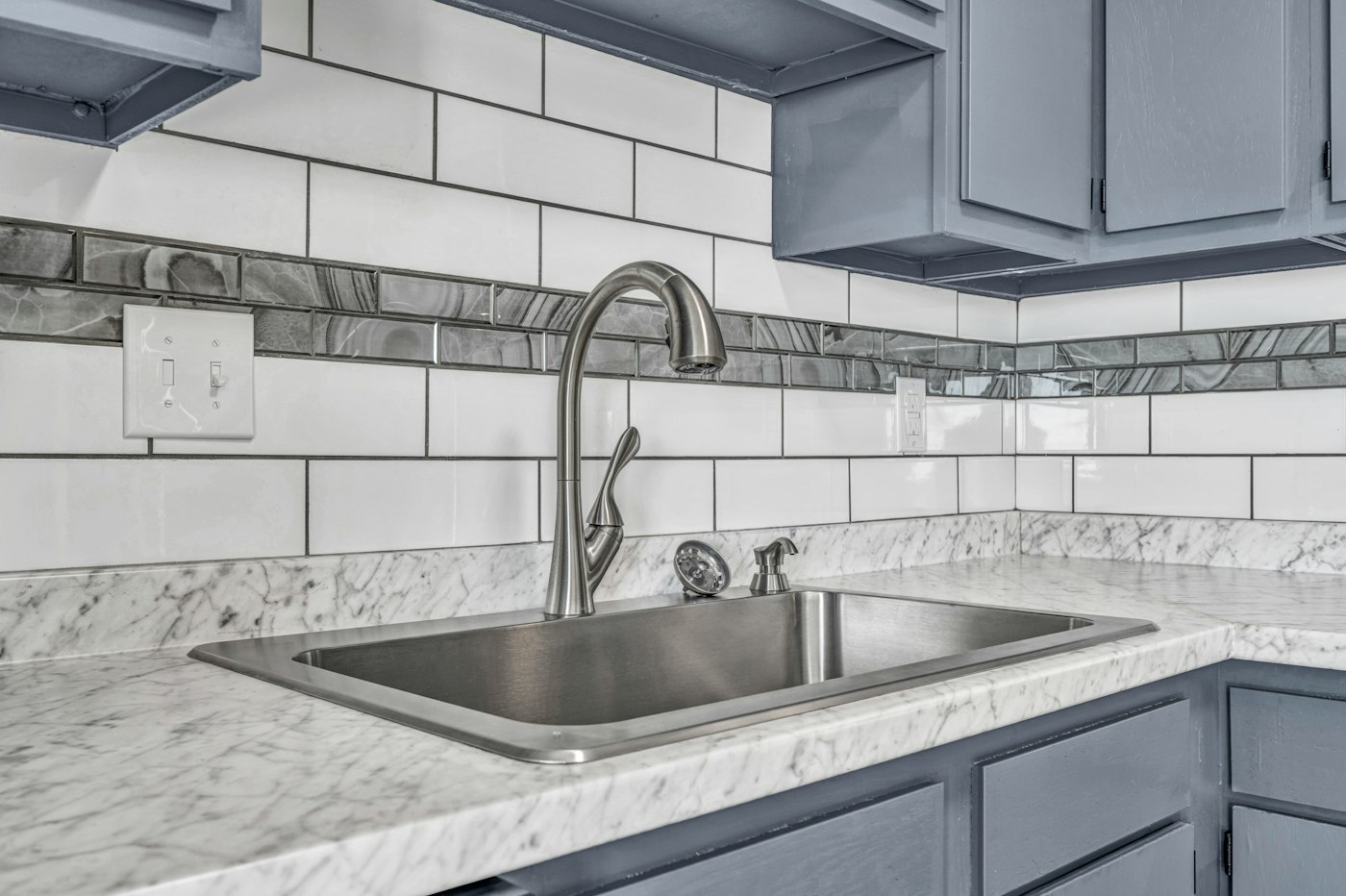
A kitchen faucet is turned on and off dozens of times a day, so its design is felt constantly even when it is barely noticed. Beyond finish, which gets most of the attention, faucets differ in how the spray works, how they are operated, how they are mounted and how far they reach into the sink. Understanding the types makes it easier to choose one that fits both the sink and the cook.
Pull-Down Faucets
The pull-down faucet, with its tall arched spout and a spray head that pulls straight down into the sink on a hose, has become the most common style in new kitchens. The high arc gives room to fill tall pots, and the spray head reaches every corner of a large or double-bowl sink. Most have a toggle between a stream and a spray, and many offer a pause button. The main considerations are height, since a very tall faucet can look out of scale or splash in a shallow sink, and the quality of the docking mechanism that holds the head in place, which on good models uses a magnet.
Pull-Out Faucets
A pull-out faucet has a lower, straighter spout, and the entire head pulls out toward you. The lower profile suits kitchens with a window or shelf close above the sink and works well in smaller sinks where a high arc would splash. The hose is often longer than a pull-down’s, which makes it handy for filling pots on the counter or rinsing the sink’s edges. The trade-off is less clearance under the spout for tall items.
Touchless and Touch-Activated Faucets
Touchless faucets turn on and off with a wave of the hand in front of a sensor, which is a real convenience when hands are covered in dough or raw chicken. Touch-activated faucets turn on with a tap anywhere on the spout or handle. Both still have a manual handle to set temperature and flow and need power from batteries or a plug-in adapter under the sink. They cost more than manual faucets and have more parts; check the sensor placement so a cat or a passing elbow does not trigger it.
Bridge, Two-Handle and Other Styles
A bridge faucet joins separate hot and cold handles to a central spout with a horizontal bar, giving a traditional, often farmhouse look that suits classic kitchens. Many now include a pull-down or side spray. Two-handle faucets without a bridge offer the same separate controls in a widespread configuration. These styles require two or three mounting holes rather than one.
- Commercial or semi-professional faucets use an exposed spring and a flexible spray hose for a restaurant look and great reach; they are tall and prominent.
- Wall-mounted faucets free the counter behind the sink and suit apron-front sinks, but they must be planned before the wall is closed.
- Pot fillers mount on the wall over the range for filling pots in place.
- Bar and prep faucets are scaled-down versions for secondary sinks.
- Filtered-water faucets and instant hot-water dispensers occupy an extra hole beside the main faucet.
Practical Points
Match the faucet to the sink’s hole configuration; a single-hole faucet can cover extra holes with a deck plate, but a three-hole faucet cannot be installed in a one-hole sink without drilling. Check the spout reach so water lands near the drain rather than against the back or front of the sink. Consider the handle: a single lever is easiest with a wrist or elbow, and a side-mounted lever may hit a backsplash. Ceramic disc valves are the standard for long, drip-free life. Finally, choose a finish that relates to the cabinet hardware and lighting, and keep in mind that the faucet is a fixture you can swap later with modest effort, which makes it a good place to indulge a bit of style.
Choosing a Faucet Step by Step
With so many styles and features, it helps to work through the choice in order, starting with the things that cannot easily change.
- Start with the sink. Note the size, depth and number of bowls, and whether the sink is undermount, drop-in or apron-front. A deep single bowl suits a tall, high-arc spout; a shallow bar sink needs something lower.
- Count the holes. Check how many holes the sink or counter has, or will have, and plan for any extras such as a soap dispenser, filtered-water tap or air gap for the dishwasher.
- Check the clearance. Measure from the counter to any window sill, shelf or cabinet above. Tall faucets need room for the spout and for the handle to move through its full range.
- Decide how you will use it. Think about filling pots, rinsing produce, washing large pans and cleaning the sink itself.
- Choose the operation. Single lever, two handles, touch or touchless.
- Pick the finish last. Choose a finish that coordinates with hardware, lighting and appliances.
Caring for a Kitchen Faucet
- Clean gently. Use mild soap and a soft cloth. Abrasive pads and harsh cleaners can damage finishes.
- Dry it off. Wiping the faucet after use helps prevent water spots and mineral buildup, especially on dark and polished finishes.
- Clean the aerator. If the flow weakens or sprays unevenly, unscrew the aerator and rinse out debris and mineral deposits.
- Check the hose. Pull-down and pull-out hoses can kink or wear. Make sure the counterweight under the sink moves freely.
- Replace batteries. Touchless faucets often show a low-battery signal. Keep spares on hand.
- Watch for drips. A small drip often means a cartridge needs replacement, which is usually a straightforward repair.
Common Mistakes
- Choosing by looks alone. A beautiful faucet that splashes, reaches poorly or hits the backsplash will be frustrating every day.
- Oversizing for the sink. A very tall faucet over a small or shallow sink can splash and look out of proportion.
- Ignoring water hardness. In areas with hard water, finishes that hide spots and easy-to-clean spray nozzles make life easier.
- Forgetting under-sink space. Pull-down hoses, touchless control boxes, filters and garbage disposals all compete for room in the sink cabinet.
- Skipping the test. In a showroom, operate the handle, pull the spray and check how the head docks.
Questions Homeowners Ask
Can we install a new faucet ourselves?
Many homeowners can replace a faucet with the same hole configuration using the included instructions. If supply valves are old, the sink needs new holes or the cabinet is cramped, a plumber may be the better option.
Do touchless faucets save water?
They can, because water shuts off automatically when hands move away. Actual savings depend on how you use the faucet.
Should faucet and sink be chosen together?
Yes. Choosing them as a pair ensures the reach, height and hole configuration fit. We are glad to help you plan the whole sink area during your kitchen project.