
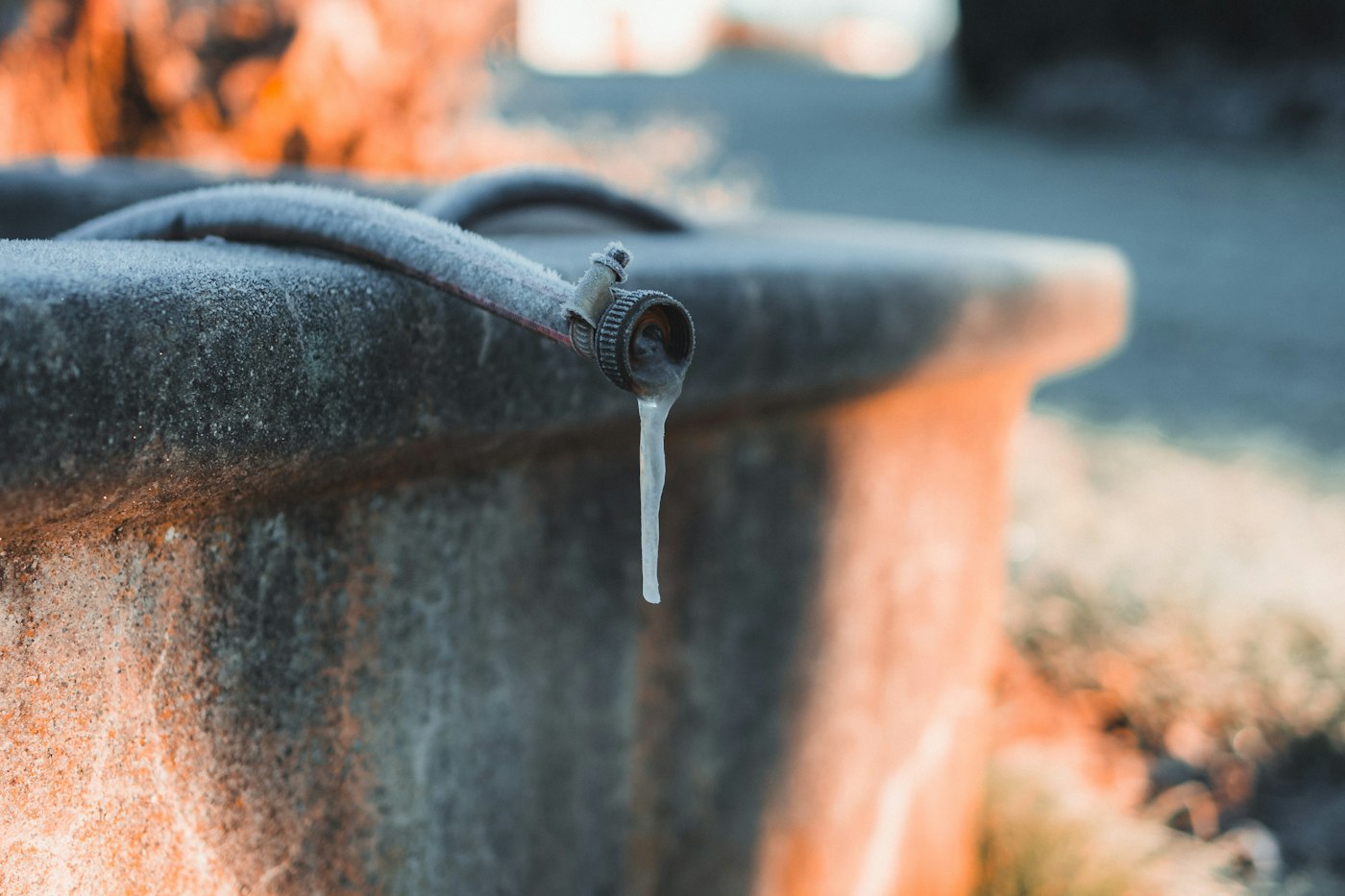
North Georgia winters are usually mild, but a few hard freezes each season are enough to damage outdoor plumbing. That is what catches so many homeowners off guard. After weeks of comfortable fall weather, a single cold night can drop well below freezing, and a hose bib that has never given trouble suddenly cracks. A cracked hose bib or the pipe just inside the wall often is not noticed until water starts showing up where it should not, in a crawl space, basement, wall cavity or ceiling below. The steps to prevent it are simple and inexpensive, and early November is the right time to take them.
Why Mild Winters Still Cause Freeze Damage
In colder parts of the country, homeowners winterize outdoor plumbing every year as a matter of routine. In North Georgia, where many winter days are above freezing, it is easy to skip. But plumbing does not need weeks of cold to fail. It takes only one night cold enough, long enough, for water trapped in a faucet or pipe to freeze.
Water expands as it turns to ice. Inside a faucet body or a copper or plastic pipe, that expansion builds pressure until something gives, often a split in the pipe or a crack in the valve. The damage frequently happens inside the wall, out of sight. When temperatures rise and the faucet is turned on, or simply as the ice thaws and pressure returns, water leaks out of the crack instead of the spout.
Exposure matters too. Faucets on north-facing walls, in wind-exposed spots or in shaded areas that never warm up during the day are the most vulnerable, as are pipes that run through unheated garages and vented crawl spaces.
Disconnect Your Hoses
A hose left attached traps water in the faucet, where it can freeze and expand. Disconnect, drain and store hoses before the first freeze.
- Remove hoses, splitters, timers and spray attachments from every outdoor faucet.
- Drain each hose by stretching it out on a slope, then coil it loosely.
- Store hoses in a garage, shed or basement. Freezing can crack hoses and fittings, too.
- Do not forget faucets on the side and back of the house, by the garage or near a garden.
This one step matters even if you have frost-free faucets, because an attached hose prevents them from draining the way they are designed to.
Shut Off and Drain If You Can
Many homes have an interior shut-off valve for each outdoor faucet. Close it, then open the outdoor faucet to let remaining water drain out.
Finding the valve
Look on the pipe leading to the outdoor faucet, usually inside the house directly behind it. Common locations include the basement ceiling, the crawl space, a utility room, a laundry area or a cabinet near the exterior wall. It may be a round-handled gate valve or a lever-style ball valve.
Draining properly
- Close the interior valve completely.
- Go outside and open the faucet. Let the water run out until it stops.
- Leave the outdoor faucet open through the cold season so any small amount of remaining water has room to expand.
- If the interior valve has a small bleeder cap, open it briefly with a container underneath to help the line drain fully, then close it.
If water keeps flowing from the outdoor faucet after you close the interior valve, the valve is not sealing and needs repair. If you cannot find a shut-off at all, that is worth sorting out before the coldest weather.
Add an Insulated Cover
Foam faucet covers are inexpensive and easy to install. They add useful protection, especially on north-facing walls.
- Choose a cover that fits snugly over the faucet and seals against the siding or brick.
- Secure it with its loop or strap so wind cannot dislodge it.
- Check covers after storms and windy days.
- Remember that a cover works best on a faucet that has already been drained. It slows heat loss; it does not make a full pipe freeze-proof.
Consider Frost-Free Faucets
Frost-free hose bibs place the valve further inside the wall where it stays warmer. If your faucets are older or have frozen before, replacing them is a worthwhile upgrade.
A frost-free faucet has a long stem that reaches back into the heated part of the house. When you turn the handle off, the water stops inside the wall, and the section of pipe between the valve and the spout drains out because the faucet is installed with a slight downward slope. Many also include a built-in vacuum breaker to help protect your water supply from backflow.
Proper installation matters: the faucet must be the correct length for your wall thickness and pitched so it drains. As always, a hose must be disconnected for it to work. If a frost-free faucet leaks from the handle or drips constantly, it may need repair or replacement.
Check Crawl Spaces and Know Your Main Shut-Off
Check crawl spaces
Pipes in vented crawl spaces are vulnerable too. Make sure vents are closed for winter where appropriate and that exposed pipes are insulated.
- Insulate exposed supply pipes with foam pipe sleeves, paying special attention to pipes near vents, along outside walls and near the access door.
- Close crawl space vents for winter where your crawl space design calls for it. Some crawl spaces are designed to stay vented or are fully encapsulated; follow what is appropriate for your home.
- Make sure the crawl space access door closes and seals.
- Look for gaps in the foundation or around pipe entries where cold air can blow directly on plumbing.
- Insulate pipes in unheated garages and along exterior walls in basements as well.
Know where your main shut-off is
If a pipe does burst, shutting off the water quickly limits the damage. Make sure everyone in the house knows where the main valve is.
- Find the main shut-off valve. It is often where the water line enters the house, in a basement, crawl space, utility room or near the water heater. Some homes also have a shut-off at the meter near the street.
- Test that it turns. Valves that have not been used in years can be stiff or stuck.
- Label it clearly and keep a path to it clear.
- Show every adult and older child in the house where it is and how to close it.
- Keep any tool needed to turn it nearby.
Your Before-the-Freeze Checklist
- Disconnect, drain and store every hose.
- Close interior shut-offs and open outdoor faucets to drain.
- Install insulated covers, especially on north-facing walls.
- Note any faucets that are older or have frozen before for frost-free replacement.
- Insulate exposed crawl space pipes and close vents where appropriate.
- Locate, test and label your main water shut-off.
- Watch the forecast and finish these steps before the first hard freeze.
If you would like your outdoor plumbing checked before winter, the AX Home Pro team can help. We can locate and repair shut-off valves, replace older faucets with frost-free models and insulate vulnerable crawl space pipes so a few hard freezes do not turn into a costly surprise. Request an estimate to get started.


