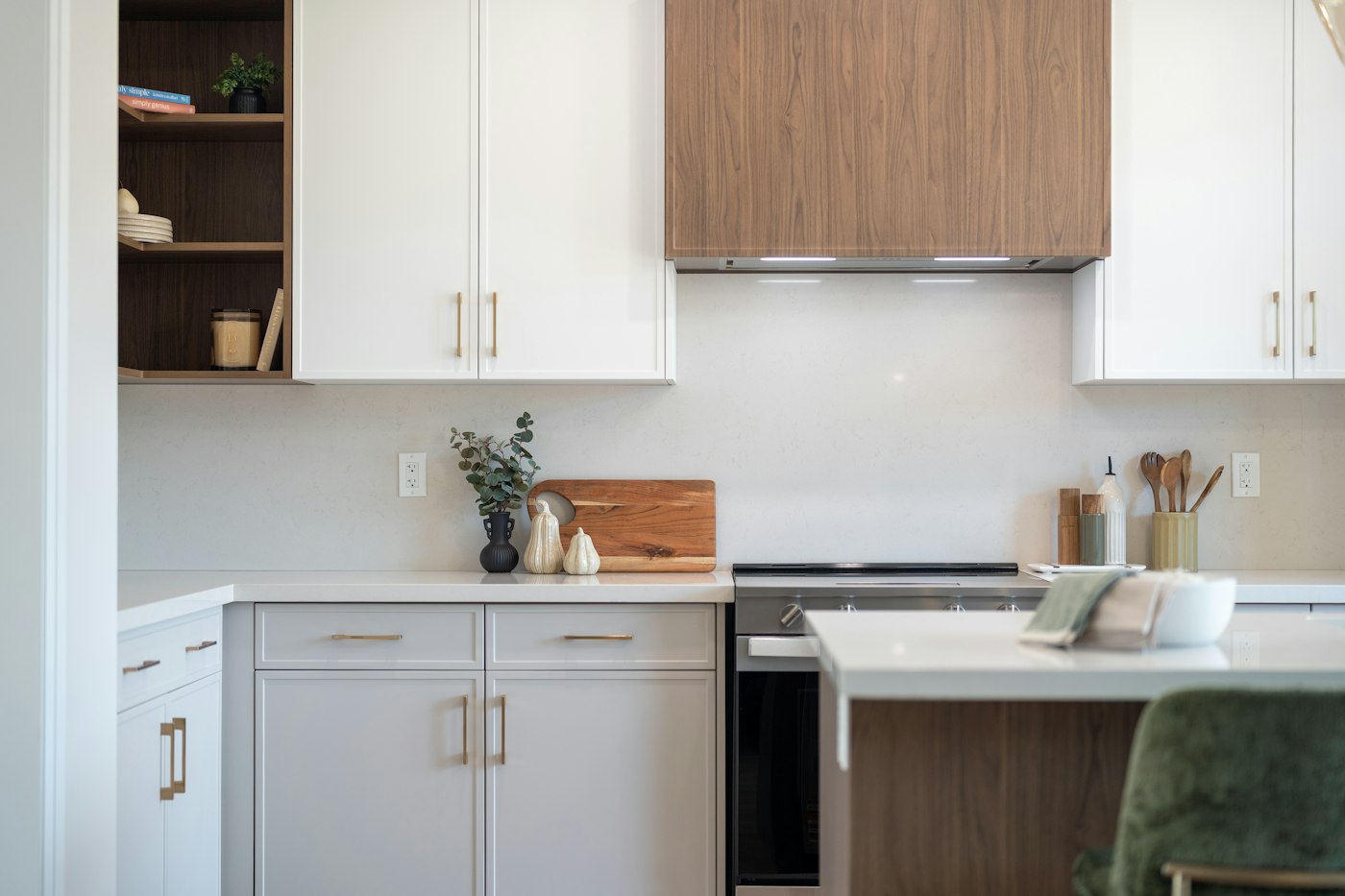
Cabinets set the tone of a kitchen more than any other element, so when they look dated, the whole room feels dated. But there is more than one way to change them. Depending on the condition of the boxes, the layout you want and how much disruption you can live with, refinishing, refacing or replacing may each be the right answer. Knowing what each path actually involves makes the choice clearer.
Refinishing: Same Cabinets, New Surface
Refinishing keeps every part of your existing cabinets and changes only the finish. That can mean stripping and re-staining wood doors, or cleaning, sanding, priming and painting them. The doors and drawer fronts are usually removed and finished separately while the frames are finished in place.
Refinishing makes sense when the cabinet boxes and doors are solid and you like the door style, but the color or the worn finish is the problem. It is the least disruptive option and preserves the layout exactly as it is. Its limits are just as clear: it cannot fix a cramped layout, damaged boxes or doors in a style you have never liked.
Refacing: New Faces on Old Boxes
Refacing replaces the doors, drawer fronts and hardware and covers the exposed parts of the cabinet frames and end panels with a matching veneer or laminate. The cabinet boxes stay where they are. Interiors can be upgraded at the same time with new drawer boxes, roll-out trays or soft-close hardware.
This is the middle path. It gives you a different door style and color and a noticeably newer look, with less demolition than a full replacement. It works best when the boxes are structurally sound and the layout already suits you. If you want to move the sink, add an island or change cabinet heights, refacing will not get you there.
Replacing: Starting Fresh
Full replacement removes the old cabinets and installs new ones. It is the only option that lets you change the layout, add storage where there was none, correct uneven or sagging boxes, and choose construction details like full-extension drawers and plywood sides throughout. It also usually means new countertops, since counters rarely survive cabinet removal, and often triggers related work on flooring, lighting and plumbing.
Replacement is the right call when the boxes are water damaged, the layout does not work, or the kitchen is being reorganized as part of a larger remodel. It is the most disruptive path and the longest, and the kitchen will be out of commission for a stretch of time.
How to Decide
- Open every door and drawer. Solid boxes with worn finishes point to refinishing or refacing. Swollen, delaminated or sagging boxes point to replacement.
- Ask whether you would keep the current layout if money were no object. If the answer is no, replacement is the honest choice.
- Consider what else is changing. If counters and floors are staying, refinishing or refacing protects them. If everything is going, replacement fits naturally.
Each path can produce a kitchen you are happy to walk into. The best one is the one that matches the condition of what you have and the kitchen you actually want. A professional who looks at your cabinets in person can tell you quickly which options are realistic.
Looking at Your Cabinets With a Critical Eye
Before deciding which path to take, it helps to evaluate your cabinets methodically. Here is the inspection we walk through with homeowners.
- Check the sink base first. This is where water damage most often shows up. Look for swelling, staining, soft spots or a floor panel that has delaminated.
- Look at the box material. Note whether the sides are plywood, particleboard or another material, and whether the face frames are solid wood.
- Test every hinge and drawer. Doors that sag, drawers that stick and slides that grind may be fixable with new hardware, or may indicate worn boxes.
- Inspect the doors. Look for warping, cracked panels, peeling finishes and loose joints.
- Check for level and alignment. Cabinets that tilt or have gaps against walls may have shifted over time.
- Evaluate the layout. Note any spots that consistently frustrate you, such as a corner you cannot reach or an appliance that does not fit.
What Each Path Looks Like in Practice
The Refinishing Process
A professional refinish usually begins with removing doors, drawer fronts and hardware and labeling every piece. Surfaces are deep cleaned to remove grease, then sanded or deglossed. Repairs are made to dings and gaps, and a bonding primer is applied before the finish coats. Doors are typically finished off site or in a dedicated area, while frames are finished in place with careful masking. Hardware is reinstalled, and doors are adjusted once everything has cured.
The Refacing Process
Refacing starts with measuring every opening precisely so new doors and drawer fronts can be ordered. Old doors and fronts are removed, and the face frames and exposed sides are covered with veneer or laminate. New doors, fronts and hardware are installed, and interior upgrades such as new drawer boxes or roll-outs can be added at the same time. Countertops, sinks and appliances usually stay in place.
The Replacement Process
Replacement typically follows a full remodel sequence: design and ordering, demolition, any plumbing, electrical and wall changes, flooring where needed, cabinet installation, countertop templating and installation, backsplash and final connections. Because new cabinets are often made to order, lead times should be factored into the schedule.
Mistakes We Help Homeowners Avoid
- Painting over damage. A new finish will not hide swollen or broken boxes for long.
- Refacing cabinets that are about to be outgrown. If you are likely to want a new layout soon, investing in refacing now may not make sense.
- Underestimating related work. Replacing cabinets often affects countertops, backsplash, flooring and lighting. Plan for those connections from the start.
- Skipping interior upgrades. Whichever path you choose, adding pull-outs, dividers and better slides can transform how the kitchen works.
Cabinet Questions We Hear
Can laminate or thermofoil cabinets be painted?
Some can be painted with the right preparation and primers, but adhesion can be challenging and peeling thermofoil is difficult to repair. These cabinets are often better candidates for refacing or replacement.
Can I add cabinets when refacing?
In some cases, new matching boxes can be added to fill a gap or extend a run, then faced with the same materials. It depends on the space and the existing cabinets.
Will my countertops survive?
Countertops usually stay in place during refinishing and refacing. During replacement they are rarely reusable, so new countertops are typically part of the plan.