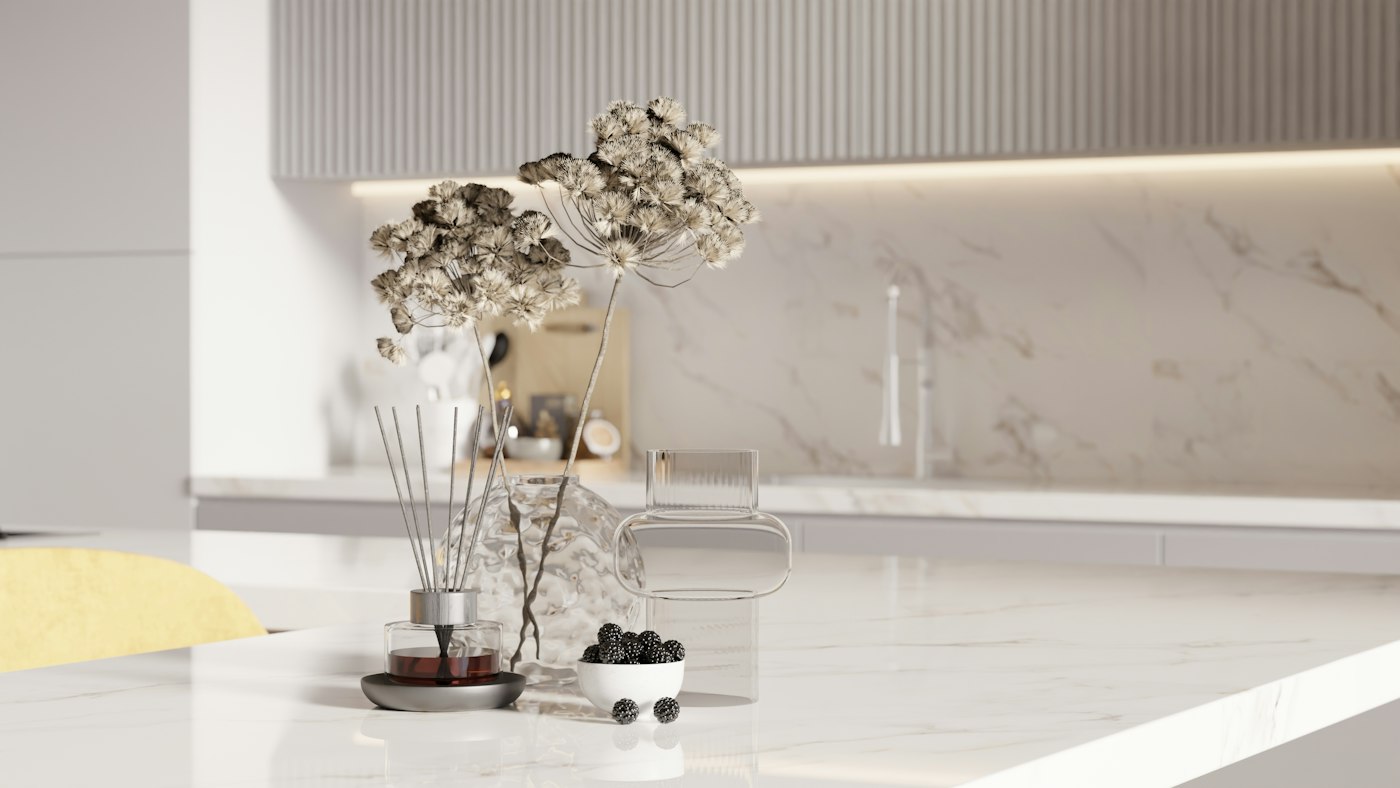
Once you have chosen a countertop material, the fabricator will ask a question that catches many homeowners off guard: which edge? The profile cut along the front of a counter affects how modern or traditional the kitchen looks, how the counter feels against your hip and how easily crumbs are wiped into your hand. Here is what the common options mean.
Eased and Square Edges
An eased edge is a square edge with the sharp corner very slightly softened. It is the most common choice today because it suits almost any style, shows off the thickness of the slab and is easy to clean. A true square edge, with no softening at all, looks very crisp but chips more readily, so most fabricators recommend at least a small ease. Thin, square profiles are the natural match for contemporary flat-panel cabinets.
Beveled Edges
A bevel cuts the top corner at an angle, usually a small chamfer that catches the light along the front of the counter. It adds a line of definition without much fuss and bridges modern and traditional styles. A larger bevel reads more decorative. Because the angled face reflects light, a bevel can draw attention to veining in stone or to a dark quartz color.
Rounded Edges
A half bullnose rounds the top corner and leaves the bottom square; a full bullnose rounds the entire edge into a half-circle. Rounded profiles are comfortable to lean against, kind to children at eye level and forgiving of bumps, which is why they have long been popular in family kitchens and bathrooms. They do make the slab look thinner and softer. A quarter round on a bathroom vanity is a subtle, classic look.
Decorative Profiles
Ogee, dupont, cove and other shaped edges carve an S-curve or a stepped profile into the stone. They belong in traditional kitchens with raised-panel cabinets and detailed moldings, where their shadows echo the trim. Decorative edges cost more to fabricate, collect a bit more grime in their curves and look best on thicker slabs or on built-up edges that give them room. Some homeowners use an ogee only on an island as a focal point and keep perimeter counters simpler.
Mitered Edges and Waterfall Ends
A mitered edge joins a strip of the same material to the front of the counter at a forty-five-degree angle, making the slab appear much thicker than it is. Thick-looking counters on a modern island are often mitered. The seam is nearly invisible when done well and allows the pattern of the stone to wrap the edge. Laminated or built-up edges achieve a similar thickness by stacking a second strip beneath the slab.
A waterfall is not an edge profile in the strict sense but a treatment of the end of a counter, where the material continues down the side of the island or cabinet to the floor. It showcases a dramatic stone or quartz and protects the end of the cabinet. It requires mitered corners for the pattern to flow and uses more material, and the surface on the side takes the same knocks as a baseboard.
- Match the edge to the cabinets: square with slab doors, rounded or ogee with traditional doors.
- Consider who leans on the counter; softer profiles are gentler.
- Ask to see your chosen edge on a sample of your actual material.
- Keep edges consistent throughout a room, or vary them deliberately between island and perimeter.
Edge profiles are a detail, but a kitchen is made of details. Choosing yours on purpose rather than by default is one of the small decisions that makes a remodel feel finished.
Choosing Your Edge Step by Step
Edge decisions are easiest when made with the whole kitchen in view. Here is the process we follow with homeowners.
- Look at your cabinet style. Flat slab doors pair naturally with eased and mitered edges, Shaker doors with eased, beveled or half bullnose edges, and raised-panel doors with decorative profiles.
- Consider the material. Some edges suit certain materials better. Stone with strong veining can look dramatic with a mitered edge, while some quartz colors show their edge construction more clearly than others.
- Think about thickness. Decide whether you want the standard thickness of the slab or a thicker appearance created with a mitered or laminated edge.
- Factor in daily use. Households with young children, frequent cooks and anyone who leans on counters may prefer softer edges.
- Look at the sink. Undermount sinks also have a polished edge along the cutout, and the profile there affects cleaning.
- View a sample. Ask your fabricator for a sample of the edge on your chosen material.
Practical Considerations by Room
Kitchen Perimeter Counters
Perimeter counters see the most cooking and cleanup. Eased, beveled or half bullnose edges are practical choices that resist chipping and make it easy to wipe crumbs into your hand.
Kitchen Islands
Islands are often the focal point, which makes them good candidates for a thicker mitered edge, a waterfall end or a decorative profile. Consider seating, since guests will rest their arms on the edge.
Bathroom Vanities
Vanity tops are smaller and closer to the body. Softer edges are comfortable, and eased or beveled edges keep the look clean. Edges should be easy to wipe because toothpaste and soap residue collect there.
Bar and Laundry Areas
Simple, durable edges usually work best. These spaces often carry lighter design expectations and heavier use.
Common Edge Profile Mistakes
- Choosing a decorative edge for a modern kitchen, which can feel out of place with clean-lined cabinetry.
- Selecting a sharp square edge without considering chipping.
- Forgetting about the overhang. The edge profile on an island with seating affects comfort.
- Not viewing a physical sample. Edges look different in person than in diagrams.
- Mixing profiles without intent. Different edges in the same room can look accidental unless the choice is deliberate.
Edge Profile Questions We Hear
Which edge is easiest to clean?
Simple profiles such as eased and half bullnose edges are generally easiest to clean, since they have fewer grooves for crumbs and residue to settle into.
Can the edge be changed after installation?
Some edges can be modified on site by a skilled fabricator, but options are limited and the process can be messy. It is best to decide before fabrication.
Does a mitered edge hold up over time?
When fabricated and installed properly, a mitered edge is durable. As with any seam, careful workmanship matters.