
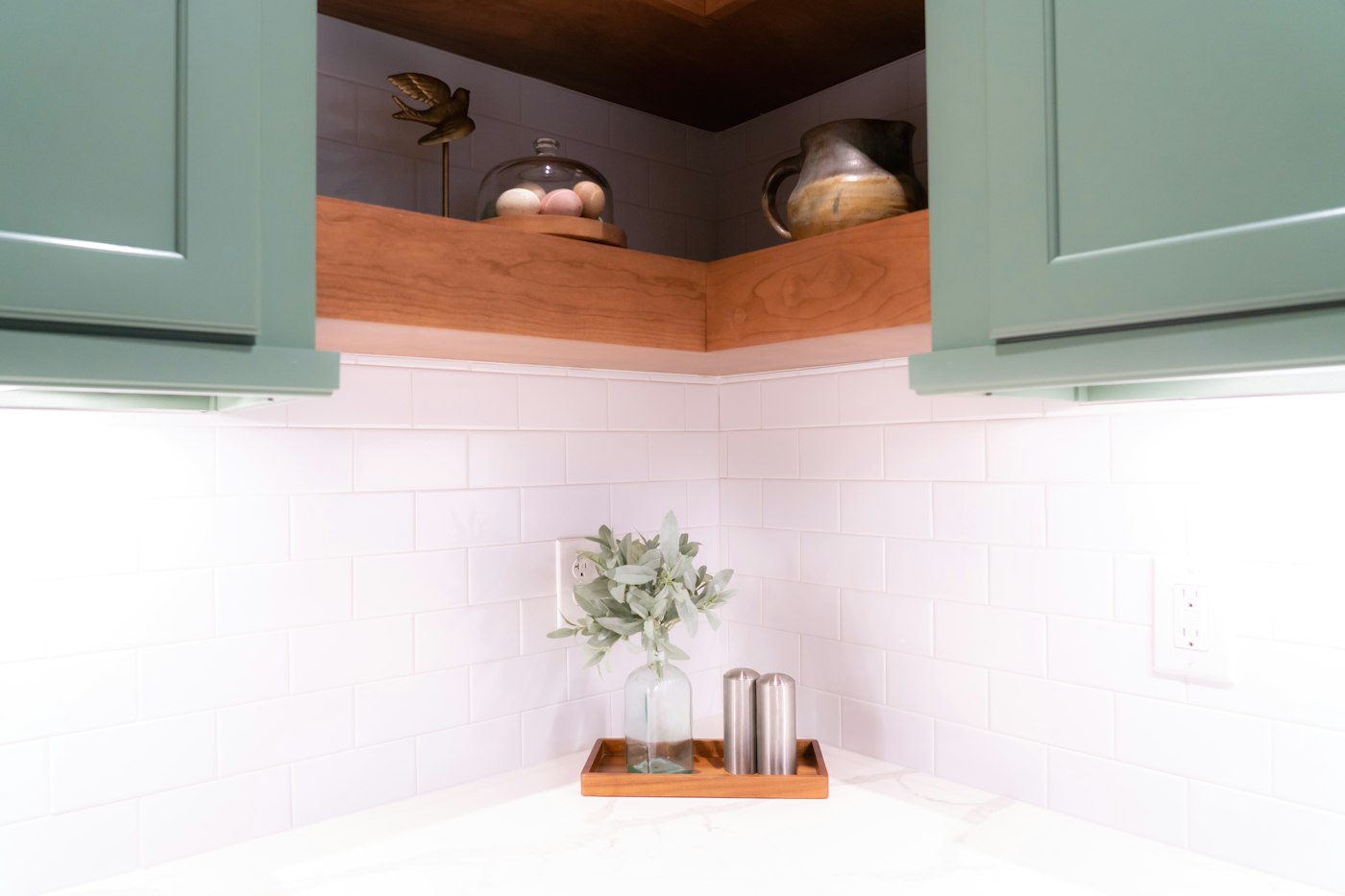
Almost every L-shaped or U-shaped kitchen has a corner where two runs of base cabinets meet. Without a plan, that corner becomes a deep, dark cave where roasting pans go to be forgotten. If a fall kitchen remodel is on your calendar, summer is when cabinet layouts get drawn, and the corner deserves attention before the order is placed. There are several good ways to solve it, and the right one depends on the cabinet layout, the budget and what you intend to store.
Two Kinds of Corners
A blind corner cabinet extends into the corner behind the adjoining cabinet run, so part of its interior is hidden. Its door sits beside the corner rather than at it. A diagonal or L-shaped corner cabinet fills the corner with a box whose door faces the corner directly, either across a diagonal front or with a hinged pair of doors that fold together. Which type you have, or choose, determines which hardware fits.
Options for Corner Cabinets
- Lazy Susans: rotating shelves, either full-round, kidney-shaped or pie-cut to fit an L-shaped door. They are simple and durable and work well for pots, mixing bowls and small appliances. Items can slide off the back edge unless the shelves have a raised rim.
- Swing-out and pull-and-glide units: designed for blind corners, these bring shelves from the hidden area out into the open. Some use linked shelves that slide forward and sideways in one motion. They make excellent use of the space but have more moving parts and need sturdy installation.
- Half-moon pull-outs: curved shelves that swing out of a blind corner on a pivoting arm, a simpler option that reaches part of the hidden space.
- Corner drawers: drawers built with a pointed, V-shaped front that pull out diagonally from the corner. They are less common, but they bring the full benefit of drawers into the corner.
- Access from the other side: on a peninsula, the corner space can sometimes open from the back as a cabinet or open shelf facing the dining area.
Do Not Forget the Upper Corner
Wall cabinets meet in the corner as well. A diagonal wall cabinet or an upper lazy Susan makes that space more reachable, and some kitchens use open corner shelves for everyday dishes or favorite pieces. Glass doors on a corner wall cabinet can brighten a dark corner, especially with interior lighting.
How to Choose
Think about what will go in the corner. Large, light items such as colanders and salad bowls suit lazy Susans. Heavy cookware needs hardware rated for the load. If anyone in the household has trouble bending or reaching, units that bring items fully forward are worth extra attention. Make sure handles and appliances on adjoining cabinets leave room for doors and pull-outs to open fully; a filler strip between the corner cabinet and its neighbor is often needed for that reason. Some corner hardware can be retrofitted into existing cabinets, while other systems must be chosen with new cabinets.
A corner should be some of the most generous storage in the kitchen, not the least used. If you are planning cabinet layouts for a remodel, our contact page is the easiest way to start the discussion.
Working Through the Corner When You Plan the Layout
Corner decisions are easiest when they happen early in the design, before appliance locations and cabinet widths are locked in. Here is the order we follow when laying out a kitchen with a corner.
- Place the major appliances first. Sinks, dishwashers and ranges have fixed widths and clearance needs. A dishwasher right beside the corner, for example, can block a corner door or pull-out when both are open.
- Decide which run the corner belongs to. A blind corner cabinet can be “pulled” a few inches along its run, which changes how much of it is hidden and how wide the door opening is. That flexibility can help other cabinets fit better.
- Pick the hardware before ordering. Many corner systems require a specific cabinet width, door size or interior configuration. Choosing the hardware after the cabinets arrive can mean it will not fit.
- Check door and drawer clearances. Handles on adjoining cabinets, a thick countertop edge or a range handle can collide with corner doors. Fillers prevent that but take up a few inches.
- Consider the countertop above. The corner is often a good place for small appliances that stay plugged in, such as a coffee maker. Storage for related items directly below makes sense.
What to Store in the Corner
Matching the contents to the hardware is what makes a corner work day to day.
- Lazy Susans: mixing bowls, colanders, food storage containers, baking supplies and small appliances used every week or so.
- Swing-out and pull-and-glide units: pots and pans, especially with lids stored alongside, and items you want visible and reachable without kneeling.
- Half-moon pull-outs: lighter cookware and bakeware, such as sheet pans stored flat or casserole dishes.
- Corner drawers: utensils, linens or flat items you reach for often.
- Back-access cabinets on a peninsula: seasonal serving pieces, entertaining items or things used at the table.
Mistakes to Avoid
- Treating the corner as overflow. If the corner is filled with things nobody uses, the solution only adds cost. Plan specific contents for it.
- Overloading a rotating shelf. Lazy Susans have weight limits. Cast iron and heavy stand mixers may be better stored in drawers.
- Choosing complicated hardware for a rental or a short-term home. Elaborate mechanisms add cost and maintenance; a simple lazy Susan or half-moon may be the better value.
- Ignoring the toe kick and base trim. In corners, the toe kick and any decorative base molding need careful detailing so they do not interfere with doors or look awkward.
Questions We Hear
Can I add a corner pull-out to my existing cabinets?
Often, yes. Many retrofit kits are designed for standard blind corner cabinets. Measure the door opening, interior depth and width carefully, and check that face frames and hinges will not block the unit.
Is it ever better to leave the corner empty?
In some layouts, closing off a small corner and using wider cabinets on either side gives more usable storage overall. We compare both options on the plan.
Do corner drawers work in every kitchen?
They need enough depth and width on both runs and are usually ordered as part of new cabinetry, so they are best decided early in a remodel.


