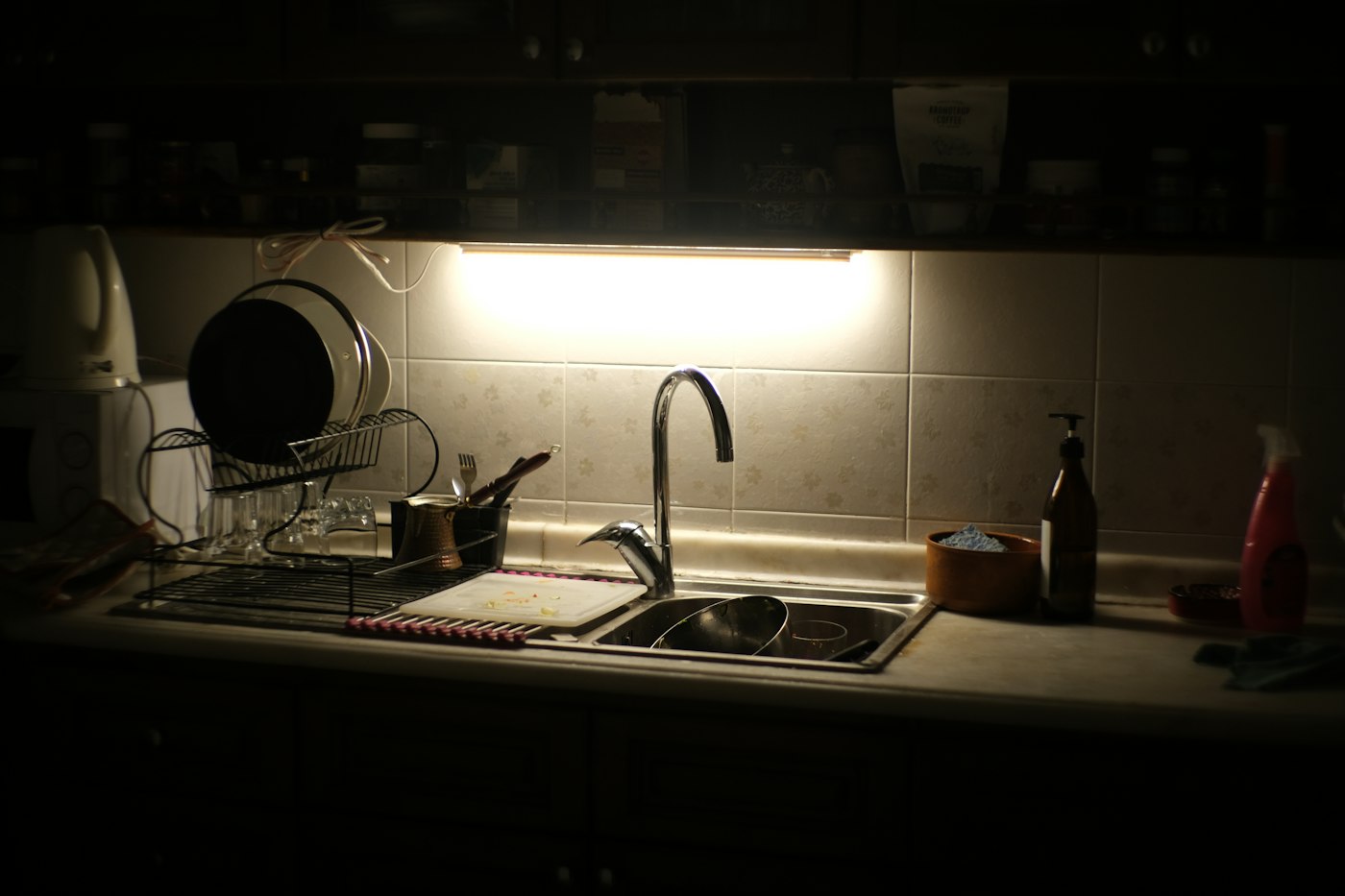
If you could make only one lighting change in a kitchen, under-cabinet lighting would be a strong contender. It puts light directly on the counter, right where you chop, measure and read recipes, and it eliminates the shadows that ceiling lights create when you stand at the counter. Several types of fixtures can do the job, each with its own strengths.
LED Tape and Strip Lights
LED tape is a thin, flexible strip of small LEDs that can be cut to length and mounted under cabinets, often in an aluminum channel with a diffuser. It produces a continuous line of light with no gaps, which looks clean and spreads light evenly across the counter. Strips are very low profile, so they hide easily behind a cabinet’s bottom edge or light rail. Using a diffuser helps avoid the dotted, spotty look that bare LEDs can create on glossy countertops.
Puck Lights
Puck lights are small, round fixtures that create pools of light. They can add a warm, decorative effect and work well inside glass-front cabinets or open shelves. Under cabinets, they can create a scalloped pattern on the backsplash and leave darker areas between fixtures unless spaced closely. Some homeowners like this effect for accent lighting, while others prefer the evenness of strips or bars.
Light Bars
Linear light bars are rigid fixtures in fixed lengths. They are easy to install, offer even light and often include on-fixture switches or dimmers. Bars come in a variety of lengths so you can match them to cabinet widths. They can be slightly more visible than tape, depending on the cabinet design, but a light rail or recessed cabinet bottom usually hides them.
Power and Control Options
- Hardwired: Connected to your home’s electrical system and controlled by a wall switch. This is the cleanest option and is easiest to plan during a remodel, when walls and cabinets are open. Use a licensed electrician and follow local code.
- Plug-in: Connects to an outlet. Simpler to add later, though cords need to be managed.
- Battery-powered: Easy to install but require regular charging or battery changes, so they tend to suit occasional or accent use.
Many LED systems use a low-voltage driver, sometimes called a transformer, which needs a location where it can be accessed and stays ventilated. Confirm that the driver and dimmer are compatible.
Placement Tips
- Mount fixtures toward the front of the cabinet bottom to light the full counter and reduce glare on the backsplash.
- Choose a color temperature that matches the rest of the kitchen lighting.
- Look for high color rendering so food and finishes look natural.
- Consider a light rail or trim strip to hide fixtures from view when seated.
- Plan lighting runs before cabinets and backsplash are installed.
Under-cabinet lighting is a practical upgrade that also makes a kitchen feel warm and inviting at night. If you are planning kitchen lighting as part of a remodel, reach out through our contact page.
Planning Under-Cabinet Lighting, Step by Step
Under-cabinet lighting is simplest to get right when it is designed alongside the cabinets. Here is a practical way to plan it.
- Map the counter runs. List every stretch of upper cabinets and note their widths. Note where countertops have no cabinets above, such as under a window.
- Choose the fixture type. Decide whether you want continuous strips, rigid bars or pucks, based on how even you want the light and how the cabinets are built.
- Decide on control. Choose a wall switch, dimmer, on-fixture switch or smart control. Many people like a single switch that controls all under-cabinet runs at once.
- Locate the driver or power supply. Plan an accessible, ventilated spot for any low-voltage drivers, often inside a nearby cabinet or above the cabinets.
- Plan the wiring path. Cabinets are drilled or notched for wires before installation. Coordinate this with your electrician and cabinet installer.
- Coordinate with the backsplash. Make sure wires or junction boxes do not end up where tile or a slab backsplash will go.
- Test before trim. Turn the lights on before final trim and light rails are installed, so adjustments are easy.
Matching Fixtures to Your Kitchen
Glossy countertops and backsplashes
Polished stone, quartz and glossy tile reflect light sources. Diffused strips or bars mounted near the front edge of the cabinet reduce bright dots and glare.
Matte surfaces
Matte countertops and tile are more forgiving of visible LEDs, so a wider variety of fixtures can work well.
Glass-front and open shelving
Puck lights inside cabinets or under shelves can highlight dishes and glassware, adding an accent layer to the kitchen.
Older cabinets without a recessed bottom
A slim light bar or tape in a low-profile channel, paired with a simple trim strip, can keep fixtures out of view.
Under-Cabinet Lighting Mistakes to Avoid
- Mounting fixtures against the wall. Lights at the back of the cabinet create glare on the backsplash and leave the front of the counter dim.
- Leaving gaps between fixtures. Spacing pucks too far apart or using bars shorter than the cabinet creates dark spots.
- Mixing color temperatures. Under-cabinet lights that are warmer or cooler than ceiling lights make the kitchen look patchy.
- Forgetting the corners. Corner cabinets and the ends of runs often get skipped, leaving dark patches where you work.
- Burying the driver. Drivers need to be accessible for replacement and ventilated to stay cool.
Under-Cabinet Lighting Questions We Hear
Can I add under-cabinet lights to an existing kitchen? Often, yes. Plug-in and battery fixtures are the easiest to add, while hardwiring may be possible depending on access to wiring and outlets.
How bright should under-cabinet lights be? Bright enough to read a recipe and chop safely, but not so bright that they overpower the room. Dimmers give you flexibility for both tasks and evening ambiance.
Do LEDs get hot under cabinets? LEDs run much cooler than older under-cabinet options, though drivers and fixtures still produce some heat and need airflow.
Can under-cabinet lights work as a night light? Many homeowners leave dimmed under-cabinet lights on in the evening for a soft glow in the kitchen, which can be easier on the eyes than overhead light late at night.
Planned well, under-cabinet lighting becomes one of those features you use every single day without thinking about it, simply because the counter is always easy to see and pleasant to work at.